Audio & video

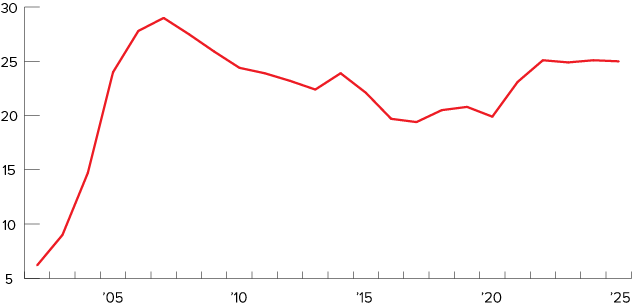
How Qmusic's market share grew since 2001
Qmusic DJ Matthias Vandenbulcke at the Q-Beach House on Ostend beach.
The success of Qmusic in Flanders and the Netherlands
“With radio, you build a relationship”
(and that takes time)
Qmusic is preparing to celebrate its 25th anniversary in Flanders and has now been active in the Netherlands for 20 years. The occasion is underscored by impressive figures. But the road to the top required belief and patience. This is how that success came about.
Normally, Koen and Kris Wauters of Clouseau would never perform at six o’clock in the morning. But on Monday 12 November 2001, they made an exception. At the crack of dawn, they opened the radio show hosted by Erwin Deckers and Sven Ornelis, thereby launching Qmusic, the first national commercial radio station in Flanders. It was nothing short of a revolution in radio.
Michael Dujardin was one of its first listeners. The current Channel Director of Qmusic was instantly won over, not least because he understood what Qmusic was aiming to be. “Not just another radio station like so many others, but a very distinctive radio brand. The DJs were positioned as personalities and there were major creative campaigns with original prizes. That was something special.”
But unlike television, radio is a long-term medium – it takes time to build loyalty. “It was not an immediate runaway success,” Christian Van Thillo, Executive Chairman of DPG Media, reflected in last year’s annual report. “The CEO of the public broadcaster rather spitefully remarked that there was evidently no demand for commercial radio. For us, that was extra motivation to make Qmusic a success – to improve every single day. It was only after three years that the formula finally began to catch on.”
In 2005, Qmusic suddenly grew at a spectacular rate, reaching a market share of 24%. “If you’re ambitious, of course you hope listeners will take to it just as quickly,” Dujardin says. “That takes time, but everyone remained convinced: this is something that sets us apart. We believe in our story and we persevere. That’s how it ultimately worked in Flanders, and later in the Netherlands too.”

“It was only after three years that the formula finally began to catch on”


Qmusic DJ Mattie Valk during the Foute Uur Party.
Qmusic reaches
1.5
million Flemish people weekly and
4.3
million people in the Netherlands
Qmusic has a
25%
share in Flanders (ages 18-44) and
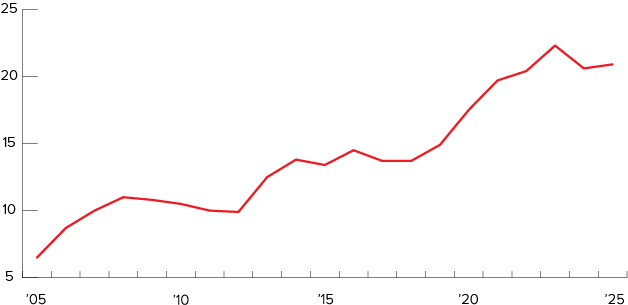
21%
in the Netherlands (ages 20-49)
Opportunity in the Netherlands
In the year that Qmusic made the big leap forward in Flanders, an enormous opportunity suddenly arose on the other side of the border as well. John de Mol was so eager to get rid of his station Noordzee FM that he sold the license for 1 euro to De Persgroep. They thereby acquired the frequency with the best coverage in the Netherlands (100.7 FM). Flemish pioneers like Erwin Deckers, Peter Bossaert and Dirk Lodewyckx set up Qmusic Netherlands.
On Wednesday, August 31, 2005, at half past eight in the evening, the transition took place. One moment Noordzee FM was still on air, the next moment Qmusic started. In the first years, the station lost a lot of money. There was not yet a large market share and the fixed costs continued; the acquired license alone cost 10 million euros per year. “Radio is an all-or-nothing game,” Van Thillo was quoted as saying in the media at the time. He estimated the chance of success in the Netherlands at 70 percent.
Here too, patience was put to the test. Robert Bernink, general director Radio in the Netherlands, likes to make the comparison with friendship. “You don’t become friends in a day either. Radio is intimate and comes very close. If you are alone in the car, the radio is the friend sitting next to you. You have to take the time to build a relationship, just like in real life.”
From 2012 onwards, Qmusic found its way up. The mission of the station was then clearly described. “Bringing fun, energy and a good feeling into the lives of our listeners,” said Bernink. “Every minute of the day, 365 days a year. Always with our listener central: without you there is no Q. We have since strictly implemented that in everything we do.”
Qmusic climbed to the second position on Dutch radio. In 2017 there was still an unexpected setback: the much-discussed break-up between the morning duo Mattie & Wietze cost Qmusic 350,000 listeners in one day. “The brand was established and had meanwhile grown into a brand with a strong image or even a strong reputation through a consistent and coherent radio sound. Because of that, the existing course could be maintained. Nevertheless, it took a year and a half to get back to that previous level.”
“Qmusic now has 1.5 million listeners a week in Flanders and has been market leader in the Netherlands for six years”
Unite and excite
In Flanders too, it is crystal clear what Qmusic stands for. “Everyone on our team knows that,” says Dujardin. “That’s the basis on which we make all of our choices: this artist yes, that one no; this campaign yes, that one no. We focus on the young, active Fleming who loves life. Unite and excite: we do it together with the listeners, whom we accompany throughout the day, and we do unexpected things that only Q can do. We make people think: how did they manage to pull that off?”
Keeping listeners engaged and continuing to surprise them – that’s how they do it in the Netherlands too. “In hospitality, the rule is: you’re only as good as the last visit,” Bernink explains. “If it’s not right once, people will forgive you. The second time, they start to doubt. By the third time, they start looking at another restaurant. Radio works in exactly the same way. If we keep bringing out the best in ourselves every day, deliver quality and exceed people’s expectations, then we’re always delivering the best possible product and people feel no need to go elsewhere.”
Still hugely popular
The figures speak for themselves. Qmusic now has 1.5 million listeners a week in Flanders. In the Netherlands, Qmusic has been market leader for six consecutive years. The breakfast shows of Maarten & Dorothee and Mattie & Marieke remain hugely popular. Het Geluid and Het Foute Uur have become household names, and the events are bursting at the seams. In the summer of 2025, the Q-Beach House attracted no fewer than 340,000 people to the beach at Ostend. In the Netherlands, the Foute Uur Party will move in 2026 from the Brabanthallen to the Philips Stadion in Eindhoven.
These are the kinds of successes Christian Van Thillo could only dream of when Qmusic launched in 2001 and expanded in 2005. Qmusic has made it, and it has also taught him a great deal. “That was the big lesson for us: if you believe in the formula, then persevere, be patient and don’t let anything or anyone distract you. Radio has become a fantastic adventure for our group – with a great future ahead.”
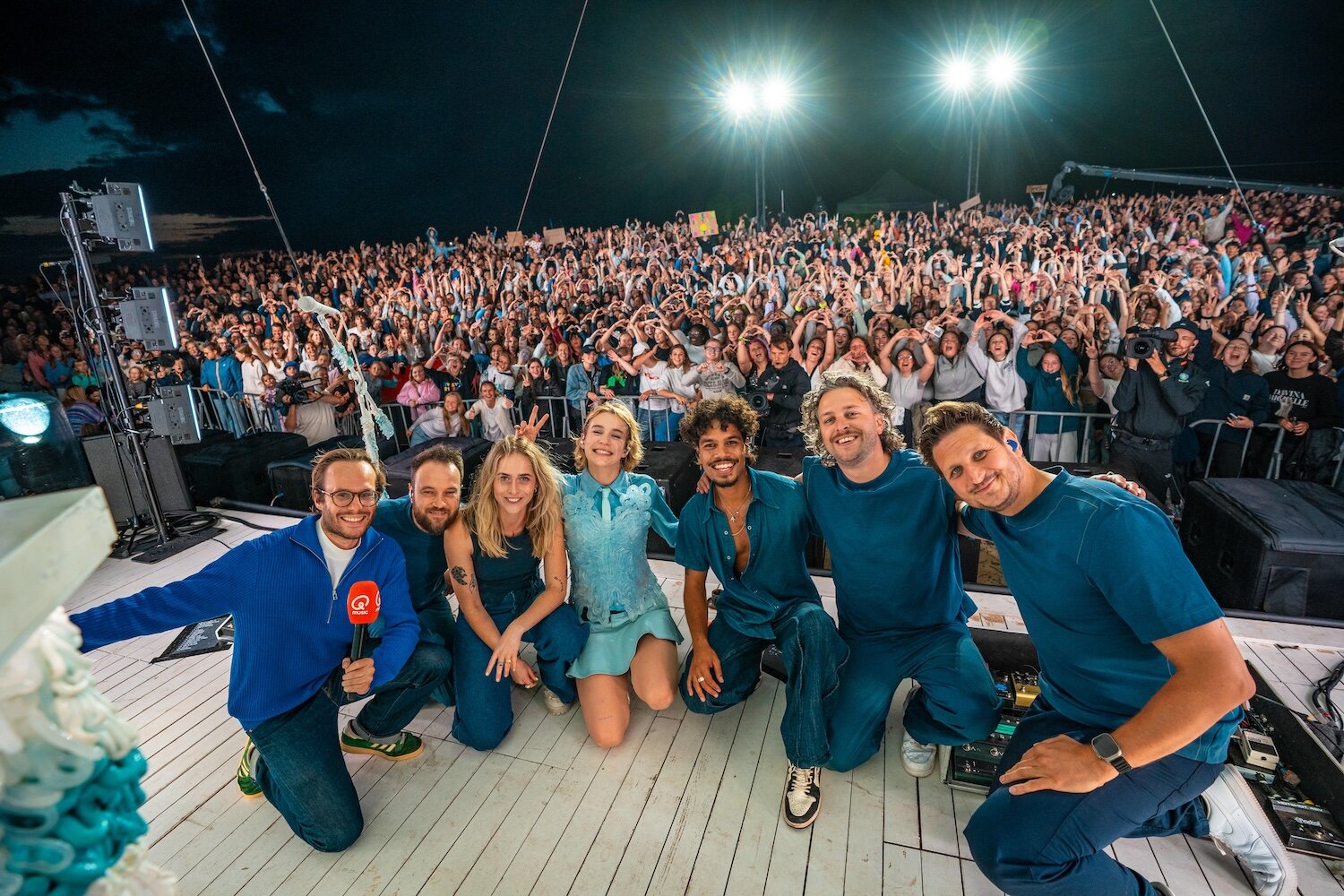
Pommelien Thijs and her band after the Sunset Concert for 25,000 fans at the Q-Beach House.


Qmusic market share in Flanders (aged 18-44):
Qmusic market share in the Netherlands (aged 20-49):